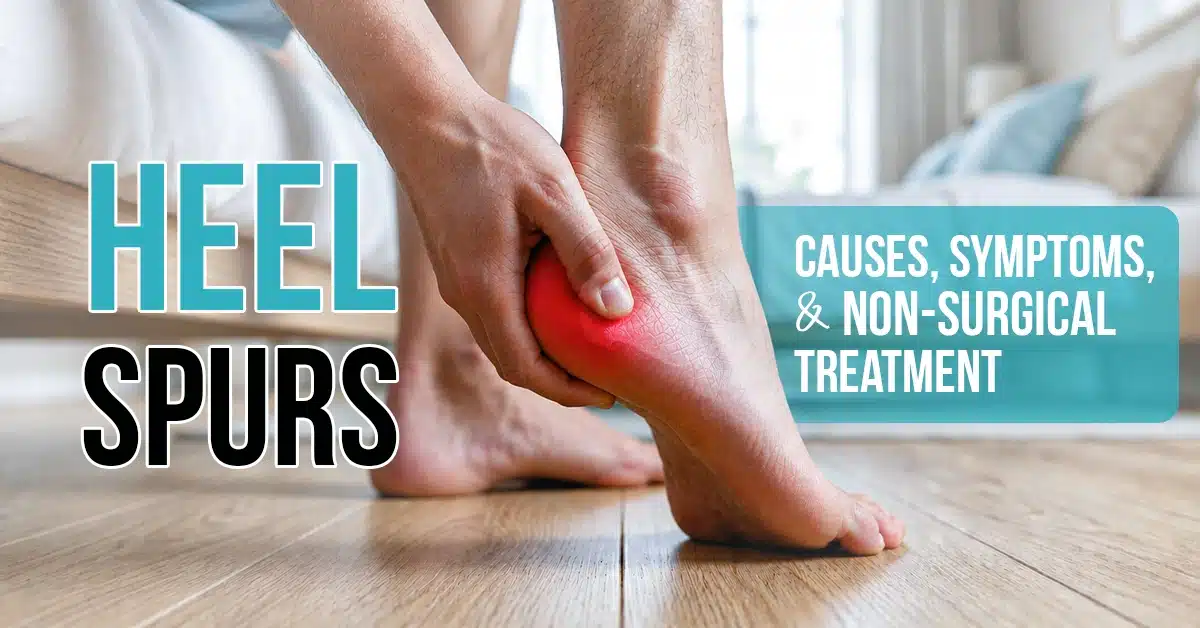
A heel spur diagnosis is one of the most common reasons patients in Ontario are referred for imaging, prescribed orthotics, or—in some cases—recommended for surgery. Most of that intervention is based on a clinical misconception: that the bony protrusion visible on X-ray is the direct cause of the pain.
It rarely is.
Heel spur treatment outcomes improve dramatically when clinicians stop treating the calcium deposits themselves and start treating the tissue and mechanical environment that produced them. That is the approach at Physio Village—and it is the reason most of our heel spur patients avoid surgery entirely.
What Is a Heel Spur? A Clinical Definition
A heel spur—known clinically as a calcaneal spur or osteophyte—is a bony outgrowth from the calcaneus (heel bone). Two distinct types exist, and they require different clinical approaches:
Plantar calcaneal spurs form on the anterior-inferior surface of the heel bone, at the attachment point of the plantar fascia and intrinsic foot muscles. They are associated with plantar fasciitis and form as a periosteal response to chronic traction loading at the fascial origin. They are visible on lateral foot X-rays as a beak-like protrusion pointing toward the toes.
Posterior calcaneal spurs (also called Haglund’s deformity) form on the posterior-superior surface of the calcaneus, at or near the Achilles tendon insertion. They are associated with insertional Achilles tendinopathy and retrocalcaneal bursitis, and they are provoked by heel counter pressure from footwear.
In both cases, the spur is a secondary finding—a structural adaptation to abnormal mechanical stress. Treating the spur without addressing the mechanical stress that created it is clinically ineffective.
How Calcium Deposits Form on the Heel Bone
The formation of calcium deposits at bony attachment sites is a response to chronic tensile or compressive overload at the periosteum—the thin connective tissue layer covering bone. When a structure such as the plantar fascia pulls repeatedly and excessively on its bony attachment point, the periosteum responds by laying down new bone at the insertion in an attempt to reinforce the connection.
This process—enthesopathy—is the same mechanism responsible for osteophyte formation in arthritic joints and calcific tendinopathy in the shoulder rotator cuff. It is not an isolated pathological event; it is the body’s adaptive response to a mechanical problem that has exceeded the tissue’s tolerance.
The following factors consistently drive the mechanical overload that leads to calcaneal spur formation:
- Reduced ankle dorsiflexion range—from gastrocnemius shortening or ankle joint restriction—that transfers excessive load to the plantar fascial insertion during the mid-stance phase of walking
- Weakness of the tibialis posterior and intrinsic foot muscles that allows excessive and prolonged pronation during loading response
- Increased body weight relative to the cumulative load tolerance of the plantar fascia
- Sudden increases in activity—new walking habits, weight-bearing employment, return to recreational sport—in patients who have pre-existing mechanical risk factors that were previously compensated but not corrected
Understanding these drivers is essential for treatment, because the spur will continue to cause discomfort—and may enlarge—if the mechanical factors producing it are not addressed.
Symptoms of Bone Spur Pain
Bone spur pain follows a characteristic pattern that helps differentiate calcaneal spur pain from other causes of heel symptoms:
The most common presentation is sharp, deep pain at the heel that is worst with the first few steps after rest—particularly after sleeping or prolonged sitting. The pain may ease after 10 to 15 minutes of walking, then return with extended activity. This pattern is almost identical to plantar fasciitis pain because, in most cases, both conditions are present simultaneously.
Posterior spur pain presents differently—it is located at the back of the heel, is provoked by the heel counter of shoes, and may worsen with activities involving repeated ankle dorsiflexion (running uphill, climbing stairs, cycling).
Features that suggest bone spur pain has a different primary driver—and warrant further investigation—include: constant pain that does not ease with rest; night pain that wakes the patient; significant radiating pain into the arch, toes, or up the leg; or sudden onset without any identifiable change in activity or load.
Manual Therapy for Heel Spur Treatment — The Physio Village Approach
The goal of manual therapy in heel spur treatment is not to dissolve the spur—that would require surgery and rarely produces the expected outcome. The goal is to remove the mechanical load that made the spur painful and that is driving its continued growth. When that load is removed, most patients experience substantial and lasting pain relief without surgical intervention.
Plantar Fascia and Intrinsic Foot Muscle Release
At the plantar calcaneal spur, the primary mechanical driver is excessive tensile load at the fascial insertion. Soft tissue release techniques targeting the plantar fascia—sustained deep pressure at the origin, cross-fibre friction along the medial fascial band, and instrument-assisted release of the intrinsic foot musculature—directly reduce the traction force on the periosteum.
This is not superficial massage. The plantar fascia sits beneath the calcaneal fat pad and the intrinsic foot musculature—accessing it requires clinical training in tissue palpation and force application. When performed correctly, even a single session of plantar fascia release produces measurable reductions in heel pain with the first steps post-treatment.
Gastrocnemius-Soleus Complex Release
As described in the context of plantar fasciitis, posterior calf tightness is the most consistent mechanical contributor to excessive plantar fascial load. Reducing calf hypertonicity through manual release—trigger point therapy, myofascial release of the gastrocnemius origin, and Achilles paratenon work—reduces the tensile demand on the plantar fascia at every step of the gait cycle.
The effect is measurable in ankle dorsiflexion range. Patients who arrive with less than 5° of weight-bearing dorsiflexion—a threshold that consistently correlates with plantar fascia overload—often demonstrate 10 to 15° of improvement within two to three sessions of manual calf release. That restoration of dorsiflexion changes the mechanics of every step the patient takes outside the clinic.
Joint Mobilisation and Heel Pain Management
Restricted subtalar and talocrural joint mobility is a common finding in patients with heel spur pain, and it contributes to the condition through the same mechanism as gastrocnemius shortening—by reducing the dorsiflexion range available during mid-stance.
Subtalar joint mobilisation—posteroanterior and medial-lateral calcaneal glides—restores the talar rocking motion that is essential for shock absorption during heel strike. When the subtalar joint cannot evert adequately, the foot supinates and the heel strikes laterally, concentrating impact load directly at the spur site rather than distributing it across the arch.
Midfoot mobilisation—targeting the navicular, cuboid, and cuneiform articulations—restores the interosseous movement that allows the foot to deform appropriately during loading. A rigid midfoot increases the mechanical stress transmitted to the heel because the arch cannot absorb impact effectively.
At Physio Village’s Oakville and Brampton clinics, joint mobilisation for heel spur patients is always preceded by clinical assessment that identifies the specific restriction. The approach is targeted, not blanket.
Gait Retraining for Long-Term Heel Pain Management
Even after manual therapy has restored the tissue quality and joint mechanics driving the spur pain, the movement habits that produced the problem often persist. Gait retraining—the process of correcting the foot contact pattern, step length, and loading mechanics during walking—is the final component of heel spur treatment that determines whether symptoms recur.
Specific targets in gait retraining for calcaneal spur patients typically include:
- Reducing excessive heel strike force by increasing cadence and reducing stride length
- Correcting midfoot pronation collapse during loading response through targeted hip and intrinsic foot strengthening
- Addressing shoe wear patterns and advising on footwear that supports appropriate mechanics during the remodelling phase
Gait retraining is performed in clinic using video feedback where available, and patients receive a home movement programme to reinforce the patterns developed in treatment.
Shockwave Therapy as an Adjunct to Heel Spur Treatment
Extracorporeal shockwave therapy (ESWT) delivers acoustic pressure waves to the tissue at and around the calcaneal spur. The proposed mechanisms include stimulation of neovascularisation, disruption of calcific deposits, and activation of pain modulation pathways through mechanoreceptor stimulation.
The evidence for ESWT in plantar fasciopathy is moderate to strong—multiple RCTs demonstrate meaningful reductions in pain and improvement in function, particularly in chronic cases that have not responded to conservative treatment alone. Physio Village offers ESWT as an adjunct to manual therapy for patients with heel spur or plantar fasciitis symptoms persisting beyond 12 weeks of appropriate physiotherapy.
The key clinical point: ESWT performs significantly better when combined with manual therapy than when used as a standalone treatment. It is an adjunct—a tool that enhances manual therapy outcomes in resistant cases—not a substitute for hands-on clinical care.
When Is Spur Removal Surgery Considered?
Calcaneal spur removal surgery—plantar fascia release and spur excision—is considered when all of the following conditions are met: symptoms have persisted for 12 months or more, a structured conservative physiotherapy programme of at least 6 months has not produced adequate improvement, and the patient’s function and quality of life are significantly impaired.
That threshold is reached in fewer than 5% of calcaneal spur cases. The vast majority of patients—when they receive appropriate manual therapy addressing joint mechanics, soft tissue quality, and gait patterns—achieve the clinical outcomes that make surgery unnecessary.
For patients who have already undergone surgery with unsatisfactory results, physiotherapy focusing on fascial remodelling, scar tissue mobilisation, and gait retraining after surgical intervention often produces the improvement the surgery alone did not achieve.
Heel Spur Treatment at Physio Village — Oakville and Brampton
Physio Village treats heel spur pain with a protocol that addresses the full mechanical chain responsible for the condition—not just the heel itself. The programme combines manual therapy to the plantar fascia, calf complex, and foot and ankle joints with progressive intrinsic foot strengthening, gait retraining, and structured load management.
Most patients achieve substantial, lasting heel pain management within 8 to 12 sessions. Patients with long-standing heel spurs who have not responded to previous treatment often see their most significant improvement within the first three to four sessions—once the mechanical drivers that have been overlooked in previous management are directly addressed.
Both the Oakville and Brampton locations are available without a physician referral. Same-week assessment appointments are regularly available.
Frequently Asked Questions — Heel Spur
What is a heel spur?
A heel spur is a bony outgrowth (osteophyte) from the calcaneus—the heel bone. Plantar calcaneal spurs form on the underside of the heel at the plantar fascia insertion. Posterior calcaneal spurs form at the back of the heel near the Achilles tendon. Both are secondary adaptations to chronic mechanical overload, and neither is typically the direct cause of pain—the surrounding tissue and mechanical loading are.
Do calcium deposits on the heel always cause pain?
No. Studies show that calcaneal spurs are present on X-ray in 15 to 25% of asymptomatic adults. The presence of a spur on imaging does not predict pain severity or function, and many patients with significant spurs are pain-free. Equally, many patients with severe heel pain have no visible spur on X-ray. The diagnosis and treatment approach should be based on clinical examination, not imaging findings alone.
Can heel spur treatment avoid surgery?
In the large majority of cases, yes. Fewer than 5% of heel spur patients require surgical spur removal when they receive appropriate conservative physiotherapy—including manual therapy, progressive loading, and gait retraining. Surgery produces satisfactory outcomes in carefully selected cases after conservative treatment has been exhausted.
How long does heel spur treatment take?
Most patients with plantar calcaneal spur pain achieve significant improvement within 8 to 12 physiotherapy sessions. Patients with posterior calcaneal spurs and insertional Achilles tendinopathy typically require 12 to 16 sessions. The recovery timeline is longer for patients who have had long-standing symptoms without appropriate treatment.
Does shockwave therapy remove heel spurs?
Shockwave therapy does not consistently dissolve calcific deposits in calcaneal spurs, despite popular belief. Its clinical value in heel spur treatment is through pain modulation and stimulation of tissue remodelling—not mechanical removal of the spur. It is best used as an adjunct to manual therapy in cases that have not responded adequately to conservative management alone.
Key Takeaways — Heel Spur
- A heel spur is a secondary bony adaptation to mechanical overload—the spur is rarely the direct pain source
- Calcium deposits form as a periosteal response to chronic tensile stress at the plantar fascia or Achilles tendon insertion
- Bone spur pain responds to manual therapy targeting the tissue and joint mechanics driving the overload—not the bony growth itself
- Manual release of the plantar fascia and calf complex, combined with foot and ankle joint mobilisation, produces consistent and lasting heel pain management
- Shockwave therapy is a useful adjunct for resistant cases when combined with manual therapy—not a standalone treatment
- Surgical spur removal is necessary in fewer than 5% of cases when appropriate physiotherapy is provided
- Physio Village treats heel spur pain with a sequenced manual therapy, loading, and gait retraining protocol at both Oakville and Brampton locations
Book Your Heel Spur Assessment
Share this guide: Do you know someone in Oakville or Brampton who has been told they need orthotics or surgery for a heel spur? Share this clinical guide to help them understand their options before committing to any intervention.
2-Minute Check: Sit in a chair and cross your affected foot over your knee so you can see the sole of your foot. Using your thumb, press firmly along the inner border of your heel—starting from the very back of the calcaneus and moving forward approximately 2 to 3 centimetres. Sharp, point-specific pain at one location along that line suggests a plantar fascial attachment problem (plantar spur territory). If the pain is instead at the back of the heel—at or just above the Achilles insertion—that suggests posterior spur or Achilles tendon involvement. Either finding is amenable to manual therapy treatment; the distinction determines which protocol is most appropriate.
Book Your Assessment: