
The prescription of exercises for lower back pain without a prior clinical assessment is one of the most common—and most counterproductive—approaches in musculoskeletal care. Generic back exercises, applied without understanding the mechanical cause of the pain, either fail to address the problem or actively load structures that are already irritated.
At Physio Village, the exercises prescribed for lower back pain are not selected from a standard library and handed to the patient at the first appointment. They are chosen based on clinical findings: the specific spinal segments that are restricted, the soft tissue structures generating pain, the movement pattern deficits driving abnormal spinal loading, and the neuromuscular inhibition patterns that have developed in response to pain.
That process begins with manual therapy—not exercise. The exercises that follow are built on a foundation that makes them safe, effective, and appropriate for the individual patient.
What Is Lower Back Pain? A Clinical Overview
Lower back pain is pain located in the lumbar and lumbosacral region of the spine, with or without associated leg symptoms. It is the leading cause of disability in Ontario and globally, and it is clinically heterogeneous—no two lower back pain presentations are identical in their mechanical drivers, even when they produce similar symptom patterns.
The structures capable of generating lower back pain include the intervertebral discs, the facet joints, the sacroiliac joints, the paraspinal muscles and fascia, the lumbar nerve roots, and the supporting ligaments of the lumbar spine. Identifying which of these is primarily involved determines which treatment—and which exercises—are appropriate.
The majority of non-specific lower back pain (approximately 85% of cases) involves contributions from multiple structures simultaneously. Effective management—including the selection of appropriate back pain exercises—requires treating the system, not just the symptom.
Why Exercise Alone Is Insufficient for Lower Back Pain
The evidence for exercise in lower back pain management is strong—particularly for subacute and chronic presentations. Exercise reduces pain, improves function, decreases disability, and is associated with lower rates of recurrence compared to passive treatment alone.
What the evidence does not support is exercise as the sole treatment, applied without clinical assessment of the mechanical state of the spine.
Specifically, two problems arise when exercises for lower back pain are prescribed without prior manual therapy:
Problem 1: If the lumbar spinal joints have significant accessory movement restriction—capsular tightness, facet joint adhesion, or segmental hypomobility from long-standing guarding—exercises performed through that restricted range do not restore mobility. They load the hypomobile segment, provoke protective spasm, and reinforce the compensation patterns (typically excessive movement at adjacent hypermobile segments) that the patient has already developed. The pain may initially decrease due to endorphin release from activity, then return—often worse than before.
Problem 2: If the deep spinal stabilisers (transversus abdominis, lumbar multifidus, pelvic floor) are significantly inhibited by pain—as they reliably are in patients with acute or subacute back pain—generic strengthening exercises train the global movers (rectus abdominis, iliopsoas, erector spinae) at the expense of the local stabilisers. This increases shear force on already irritated spinal segments and often causes a flare within 48 to 72 hours of beginning the programme.
Manual therapy addresses both problems before exercise begins.
Manual Therapy First — How It Prepares the Spine for Exercise
The Physio Village approach to lower back pain places manual therapy at the beginning of every treatment plan. What the physiotherapist achieves in the manual therapy phase directly determines which exercises are appropriate and at what point they can be safely introduced.
Joint Mobilisation of the Lumbar Spine
Lumbar segmental mobilisation restores the accessory movement between individual vertebral segments that becomes restricted in response to pain, protective muscle guarding, and degeneration.
Posteroanterior (PA) central pressures applied over the lumbar spinous processes assess and treat vertical segmental stiffness. Posteroanterior unilateral pressures applied to the transverse processes assess rotational restriction at the facet joint level. Rotation mobilisations in side-lying address coupled sagittal-frontal plane restrictions that affect the full functional range of spinal movement.
The clinical rationale for lumbar mobilisation before exercise is well-established. Mechanoreceptor stimulation from joint mobilisation inhibits the dorsal horn pain processing that drives protective spasm—giving the patient a genuine movement window to perform stabilisation exercises in for the first time in weeks. Restoring segmental mobility also ensures that spinal exercises load the previously restricted segments evenly, rather than concentrating all movement at the hypermobile segments above and below.
Paraspinal and Gluteal Soft Tissue Release
The paraspinal muscles—particularly the lumbar erector spinae, quadratus lumborum, and thoracolumbar fascia—develop predictable hypertonicity patterns in lower back pain. On the side of greater restriction, these muscles act as a continuous compression force on the affected facet joints and intervertebral discs. Trigger points within them can refer pain into the gluteal region and posterior thigh in patterns that mimic disc or nerve root pain.
Targeted soft tissue release of these structures—sustained pressure at trigger points, myofascial release along the thoracolumbar fascia, and cross-fibre release of the quadratus lumborum—directly reduces the compression load on the symptomatic spinal segments. In clinical practice, this typically produces a rapid reduction in resting lumbar ache and an immediate improvement in rotation range.
Hip flexor release—particularly of the iliopsoas—is equally important. A shortened iliopsoas increases lumbar lordosis and anterior shear force at the L4-L5 and L5-S1 levels, the most commonly symptomatic segments in the lumbar spine. Releasing the psoas before introducing lumbar exercises reduces the passive lumbar extension load that the exercises themselves must overcome.
Neural Mobilisation for the Lumbar Spine
When lower back pain is accompanied by sciatic-type symptoms—posterior thigh, calf, or foot pain; paresthesia; or neurological signs—a neural component requires treatment alongside the joint and soft tissue work.
Lumbar neural mobilisation uses combined hip flexion, knee extension, and ankle dorsiflexion movements to restore the mobility of the sciatic nerve and its roots relative to the surrounding structures. Performed correctly, these techniques reduce neurogenic pain, restore sensation, and improve motor recruitment in the muscles supplied by the affected nerve roots—including the gluteus maximus and the tibialis anterior, which are directly relevant to lumbar spinal stability.
Phase 1 — Lumbar Exercises for Acute and Sub-Acute Lower Back Pain
Phase 1 exercises are low-load, movement-control focused, and designed to reactivate the local stabiliser system without provoking spinal loading that exceeds the patient’s current tissue tolerance.
Pelvic Tilt
Starting position: Lying supine with knees bent, feet flat.
Movement: Gently tighten the lower abdominals, flattening the lumbar curve toward the floor. Hold 5 seconds. Release slowly.
Clinical note: This is a motor control exercise—not a strength exercise. The goal is re-establishing conscious activation of the transversus abdominis in the supine, unloaded position before any axial loading is introduced. Patients with significant multifidus inhibition will feel very little during this movement initially; that is a clinical finding, not a sign that the exercise is too easy.
Progression: Progress to posterior pelvic tilt in standing once the supine pattern is established.
Dead Bug
Starting position: Lying supine with arms extended toward the ceiling, hips and knees at 90°.
Movement: Maintaining a neutral lumbar spine (neither pressed flat nor arched), slowly lower one arm overhead and the opposite leg toward the floor simultaneously. Return slowly to starting position. Alternate sides.
Clinical note: The dead bug trains anti-extension stability—the ability to maintain lumbar neutral against the extension moment created by limb movement. It is one of the most effective early-phase spinal exercises because it is performed in a gravity-offloaded position with minimal compressive load, while still challenging the stabiliser system meaningfully. The quality of lumbar neutral throughout the movement matters more than the number of repetitions.
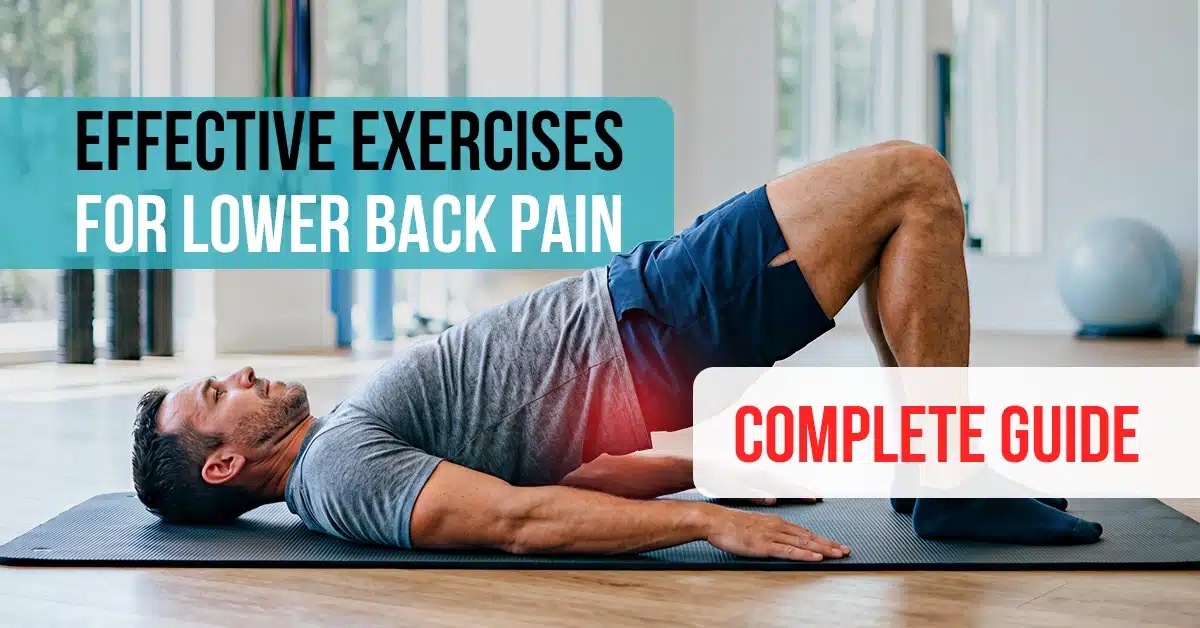
Glute Bridge
Starting position: Lying supine with knees bent, feet flat, hip-width apart.
Movement: Drive through the heels to lift the hips until the body forms a straight line from knee to shoulder. Hold 3 seconds at the top. Lower slowly.
Clinical note: The bridge activates the gluteus maximus, which is one of the primary dynamic stabilisers of the lumbosacral junction. Weakness here is consistently found in lower back pain patients and drives increased lumbar extension loading during walking, standing, and sit-to-stand transfers. Begin bilateral and progress to single-leg as control improves.
Phase 2 — Core Exercises for Spinal Stability
Phase 2 introduces progressive loading of the anterior and lateral stabiliser system. These exercises are introduced when the patient can perform Phase 1 movements with consistent motor control and without symptom provocation.
Bird Dog
Starting position: Kneeling on all fours with neutral spine.
Movement: Extend one arm and the opposite leg simultaneously, maintaining a perfectly level pelvis and neutral lumbar spine. Hold 5 seconds. Return slowly. Alternate.
Clinical note: The bird dog is the primary test and training tool for lumbar multifidus activation in a quadruped position. The multifidus is the most important segmental stabiliser of the lumbar spine and is the most reliably inhibited muscle in lower back pain. Research demonstrates that multifidus cross-sectional area decreases significantly within weeks of a back pain episode and does not recover spontaneously even after pain resolves—making specific reactivation exercises such as the bird dog non-negotiable in back rehabilitation.
Pallof Press
Starting position: Standing side-on to a resistance band or cable machine, holding the handle with both hands at sternum height.
Movement: Press the hands directly forward until the arms are straight. Hold 2 seconds. Return to sternum. Repeat.
Clinical note: The Pallof press trains anti-rotation stability—the ability to resist rotational forces that attempt to destabilise the lumbar spine. It is one of the core exercises most directly relevant to the demands of daily life (carrying a child on one side, lifting asymmetrically, turning while carrying weight) and is introduced at Phase 2 once anterior stabiliser control is established.
Modified Side Plank
Starting position: Side-lying, propped on one forearm, knees bent (modified) or legs straight (full).
Movement: Lift the hips off the floor to create a straight line from head to knees (modified) or head to feet (full). Hold for time.
Clinical note: The side plank specifically targets the quadratus lumborum and the lateral hip and trunk stabilisers—structures that are consistently underloaded in anterior-dominant core programmes. Quadratus lumborum weakness contributes to lateral spinal instability and is implicated in the lateral trunk shift that many lower back pain patients develop as a pain-avoidance posture.
Phase 3 — Spinal Exercises for Return to Function
Phase 3 introduces loading patterns that replicate functional demands—bending, lifting, carrying, and reaching—under supervised conditions. These exercises are appropriate only when Phase 1 and Phase 2 competencies have been established.
Romanian Deadlift
The hip hinge is the foundational movement pattern for safe bending and lifting. Patients who do not have a controlled hip hinge pattern load the lumbar spine in flexion during every forward bend—a pattern directly implicated in disc injury and facet joint overload.
Starting position: Standing with feet hip-width apart, neutral spine, soft knees.
Movement: Hinge at the hip, pushing the hips backward while maintaining a flat thoracolumbar spine, until hamstring tension is felt or the back begins to lose its neutral position. Return by driving through the hips.
Clinical note: This is taught and practised as a movement pattern before any external load is added. Patients are given tactile cues (a dowel rod held along the spine is a useful tool) to provide real-time feedback on spinal position. External load is introduced only once the pattern is consistent.
Goblet Squat
The squat pattern is the movement template for sitting down, standing up, and picking objects off the floor. Patients who have lost the hip flexion and thoracic extension mobility to perform a squat compensate by flexing the lumbar spine—applying compressive and shear load to the same structures that are causing their symptoms.
Starting position: Standing with feet shoulder-width apart, toes slightly turned out, holding a light weight at the sternum.
Movement: Sit back and down, maintaining an upright trunk, until the thighs are approximately parallel to the floor. Drive through the heels to return to standing.
Clinical note: Ankle dorsiflexion mobility is the most common limiting factor in patients who cannot maintain an upright trunk during the squat. This is assessed in Phase 1 and addressed through manual therapy before the goblet squat is introduced. Heel elevation with a 1 to 2 cm wedge is a temporary accommodation that allows the pattern to be practised while ankle mobility is being restored in parallel.
Flexibility Exercises for Lower Back Pain — Their Role and Limitations
Flexibility exercises—specifically lumbar rotation stretches, hip flexor stretching, and posterior chain flexibility work—have a place in back pain rehabilitation. Their role, however, is frequently overstated.
Stretching a hypermobile segment in the lumbar spine is not a treatment—it increases the instability that may be driving the pain. Similarly, aggressive lumbar flexion stretching in a patient with disc-related lower back pain can increase intradiscal pressure and provoke neurogenic symptoms.
Appropriate flexibility exercises in lower back pain include:
- Hip flexor stretch (kneeling lunge) — directly relevant when psoas shortening is contributing to lumbar extension loading. Held for 30 to 60 seconds with posterior pelvic tilt maintained throughout.
- Piriformis stretch — relevant in patients with posterior hip and buttock pain that has a muscular rather than neural component.
- Thoracic rotation — restoring thoracic rotation mobility reduces the compensatory lumbar rotation that occurs when the thoracic spine is stiff. Thread the needle, seated rotation, and quadruped thoracic extension are the most clinically useful forms.
The key distinction: flexibility exercises are most valuable in areas adjacent to the lumbar spine, not in the lumbar spine itself. The lumbar spine generally needs more stability, not more flexibility.
Back Pain Exercises to Avoid Without Clinical Assessment
Several popular exercises for lower back pain consistently provoke symptoms in patients with specific presentations:
- Full sit-ups and crunches — these produce significant lumbar flexion loading and disc compression. They are contraindicated in disc-related lower back pain and are not an appropriate core exercise for any patient at any stage—not because core training is inappropriate, but because this exercise loads the spine rather than training it.
- Standing toe touches — combined lumbar flexion and hip flexion under load from the upper body weight. In patients with disc pathology, this concentrates compressive and shear force at the most commonly damaged levels.
- Leg presses at full depth — the end of the leg press range involves significant posterior pelvic tilt, which flattens the lumbar curve and loads the lumbar spine in flexion under the compressive load of the exercise.
Exercises for Lower Back Pain at Physio Village — Oakville and Brampton
Physio Village designs back pain exercise programmed based on clinical assessment, not templates. Manual therapy is used to restore spinal joint mechanics, reduce soft tissue hypertonicity, and address neural tension before the exercise programme begins. The exercises prescribed are matched precisely to the patient’s current mechanical status and progressed based on clinical response at each session.
Patients receive a clear home exercise programme with written and illustrated instructions. Progress is tracked systematically and communicated to the patient at each visit so recovery is transparent and measurable throughout.
Both locations offer same-week assessment appointments. No physician referral is required for physiotherapy assessment in Ontario.
Frequently Asked Questions — Exercises for Lower Back Pain
What are the best exercises for lower back pain?
The best exercises for lower back pain are those prescribed after a clinical assessment of the specific mechanical cause of that patient’s pain. As a general category, lumbar stabilisation exercises—particularly those targeting the deep stabiliser system (transversus abdominis, lumbar multifidus)—have the strongest evidence base for reducing pain and preventing recurrence. The dead bug, bird dog, glute bridge, and Pallof press are commonly prescribed at Physio Village because they train stabilisation without applying compressive spinal loads.
Can exercise make lower back pain worse?
Yes, when incorrectly selected or sequenced. Exercises that load hypermobile spinal segments, train global movers at the expense of local stabilisers, or are applied in the acute phase before mechanical irritation has been adequately addressed can provoke flares. This is why clinical assessment before exercise prescription is not optional—it is the mechanism by which exercise is made safe and effective.
What are lumbar stabilisation exercises?
Lumbar stabilisation exercises are a category of back pain exercises designed to improve the function of the deep spinal stabilisers—the muscles that control intersegmental movement at the lumbar spine. They include movements such as the dead bug, bird dog, and Pallof press, and they are performed in a neutral spine position to train stabiliser activation without provoking compressive joint loading.
How long before exercises for lower back pain reduce symptoms?
Patients typically notice meaningful improvement within 3 to 4 weeks of beginning a correctly sequenced programme. Significant functional improvement—ability to return to work, exercise, or activities that were previously limited—generally occurs between weeks 6 and 12. Patients who receive manual therapy alongside their exercise programme typically progress faster than those who exercise alone.
Should I do core exercises every day for lower back pain?
Low-load motor control exercises—pelvic tilts, dead bugs, bird dogs—can be performed daily because they do not produce significant tissue fatigue. Higher-load exercises—Pallof press, split squat, Romanian deadlift—require 48 hours of recovery between sessions. The treating physiotherapist will prescribe a programme with appropriate frequency for each patient’s current load tolerance and recovery capacity.
Key Takeaways — Exercises for Lower Back Pain
- Exercises for lower back pain are most effective when prescribed after manual therapy has restored spinal joint mechanics and reduced neuromuscular inhibition
- Phase 1 focuses on reactivating the deep stabiliser system (transversus abdominis, multifidus) with low-load, movement-control exercises
- Phase 2 trains anti-extension, anti-rotation, and lateral stability using progressively demanding core exercises
- Phase 3 introduces hip hinge, squat, and loaded carry patterns that replicate functional demands
- Flexibility exercises are most valuable at the hip and thoracic spine—not in the lumbar spine, which generally needs more stability, not more range
- Sit-ups, crunches, and standing toe touches are contraindicated in disc-related lower back pain and should not be self-prescribed without assessment
- Physio Village in Oakville and Brampton designs exercises for lower back pain based on clinical findings—with manual therapy integrated at every stage of recovery
Book Your Lower Back Assessment
Share this guide: Do you know someone in Oakville or Brampton doing generic back exercises that are not producing results? Share this clinical guide to help them understand the sequenced approach that actually works.
2-Minute Check: Stand with feet hip-width apart. Slowly bend forward, reaching toward the floor, and note the point at which your lower back pain begins. Then slowly extend backward, hands on your lower back for support, and note whether this provokes pain, and where. Flexion-dominant pain (worse bending forward) suggests disc or neural involvement. Extension-dominant pain (worse bending backward) suggests facet joint involvement. Equal pain in both directions suggests a more complex presentation. Noting which direction is more provocative before your assessment gives the physiotherapist useful information before they begin the clinical examination.
Book Your Assessment: