

The muscles of your back are the unsung architects of almost everything you do — standing, sitting, lifting, reaching, rotating. When they are strong, flexible, and working in coordination, they protect your spine and support your movement. When they are weak, tight, or dysfunctional, they can contribute to pain, fatigue, and injury.
Understanding your back muscles and how to care for them is relevant for anyone dealing with back pain, recovering from an injury, or simply wanting to move better and feel stronger. At Physio Village in Brampton and Oakville, our physiotherapists regularly guide patients through back muscle rehabilitation and progressive strengthening as part of a comprehensive recovery plan.
Anatomy of the Back Muscles
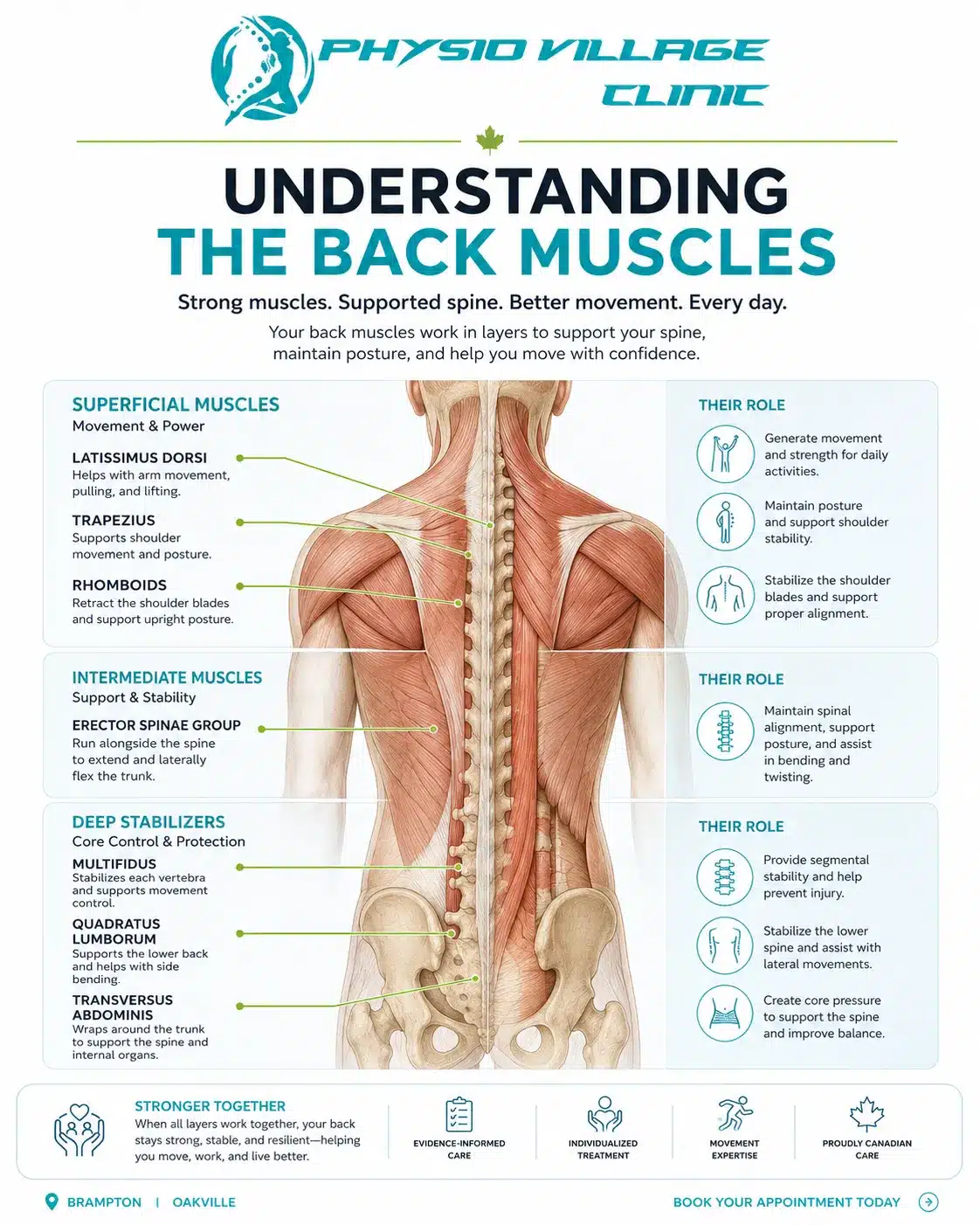
The back muscles are organized into several layers, each with specific functions related to spinal support and movement.
Superficial Back Muscles
The outermost layer includes large, powerful muscles responsible for gross movement of the trunk and limbs:
- Latissimus dorsi — A broad muscle spanning the mid-to-lower back; involved in pulling movements and shoulder extension
- Trapezius — Covers the upper and mid back; responsible for neck, shoulder, and scapular movement
- Rhomboids — Positioned between the shoulder blades; retract the scapulae and contribute to posture
Intermediate Back Muscles
This layer includes the erector spinae group — a set of three paired muscles (iliocostalis, longissimus, and spinalis) that run vertically along the length of the spine. These are the primary extensors of the back and are frequently involved in lower back pain and postural dysfunction.
Deep (Intrinsic) Back Muscles
The deepest layer contains the spinal stabilizers, which are particularly important in physiotherapy:
- Multifidus — Small, deep muscles that span a few vertebral segments and provide fine-tuned segmental stability. Multifidus often atrophies (weakens and shrinks) in people with chronic lower back pain, making its reactivation a priority in rehabilitation
- Transversus abdominis (TA) — Often considered part of the core rather than strictly a back muscle, but essential for lumbar stability
- Quadratus lumborum (QL) — Connects the pelvis to the lower ribs; involved in lateral flexion and lumbar stabilization. A common source of deep lower back tension
Why Back Muscle Strength Matters
The spinal column is inherently mobile — it is designed to move in multiple directions. This mobility is only possible because the surrounding muscles provide the dynamic stability that prevents excessive or harmful movement. When back muscles are weak or poorly coordinated, the spine bears more load than it should, increasing the risk of disc, facet, and ligament stress.
Research consistently identifies core and lumbar muscle weakness as a contributing factor in both acute and chronic lower back pain. Strengthening these muscles — particularly the deep stabilizers like the multifidus — is associated with better outcomes in back pain recovery and reduced likelihood of recurrence.
Common Causes of Back Muscle Tension
Before discussing exercises, it is worth understanding why back muscle tension develops in the first place:
- Prolonged static postures — Extended sitting or standing in one position causes muscles to fatigue and become reactive
- Muscle guarding — Following an acute injury, surrounding muscles contract to protect the area, which can persist beyond the healing phase and contribute to chronic tension
- Overuse or sudden load increase — Taking on more than the muscles are prepared for
- Poor movement mechanics — Habitual patterns of movement that place disproportionate demand on the lumbar extensors
- Stress and poor sleep — Both increase general muscle tension, including in the back
Evidence-Based Exercises for Back Muscle Strengthening
The following exercises are commonly used in physiotherapy programmes for back muscle rehabilitation. These are general examples — your physiotherapist will tailor exercises to your specific needs and ensure they are appropriate for your current level.
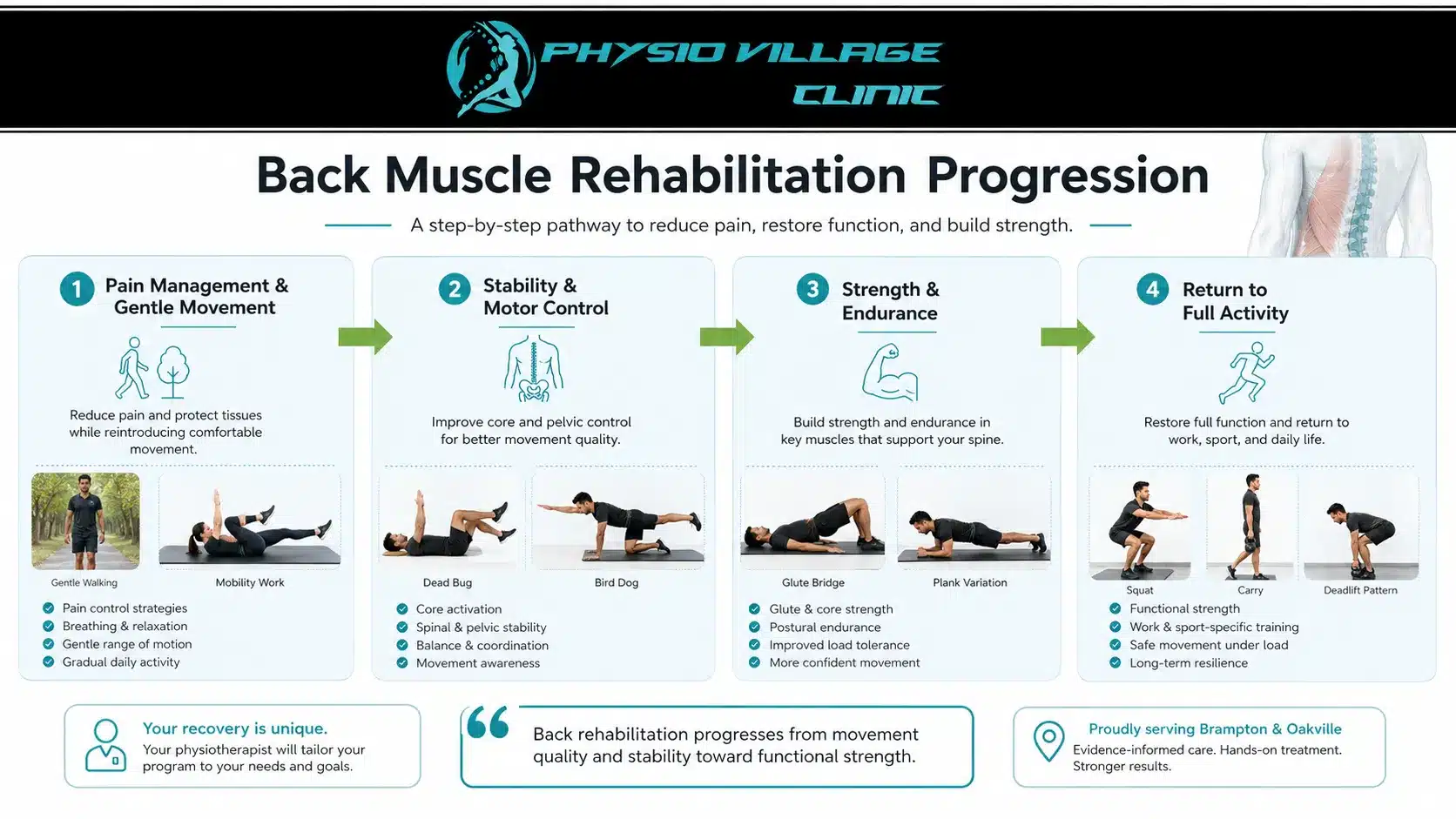
Dead Bug
The dead bug is an excellent exercise for activating the deep core — particularly the transversus abdominis — while maintaining a stable lumbar spine. It involves coordinating limb movements while keeping the lower back in a neutral position. It is a foundational exercise in many back rehabilitation programmes.
Bird Dog
The bird dog simultaneously challenges the multifidus, gluteal muscles, and core stabilizers. Performed on hands and knees, it involves extending opposite arm and leg while maintaining spinal alignment. It is a low-load, high-coordination exercise that is particularly useful in early and mid-stage rehabilitation.
Glute Bridge
The glute bridge targets the gluteal muscles, which are important partners of the lumbar muscles in managing spinal load. By building posterior chain strength, it reduces compensatory demand on the lumbar extensors.
Side-Lying Clamshell
This exercise targets the hip abductors and external rotators — muscles that significantly influence pelvic stability and, by extension, lumbar load distribution.
Plank Variations
As patients progress, plank variations can build overall core endurance. The front plank challenges the transversus abdominis and deep stabilizers, while side planks target the quadratus lumborum and obliques.
Lumbar Stabilization Progressions

Once foundational stability is established, a physiotherapist will progress exercises toward functional movement — squats, deadlifts, split squats, and carrying tasks — that replicate the demands of daily life and sport. This stage of rehabilitation is important for long-term prevention.
Recovery After Back Muscle Injury
Recovering from a back muscle strain or injury involves a staged process:
- Phase 1 — Pain Management and Gentle Movement: Focus is on managing acute pain, reducing muscle guarding, and introducing gentle movement to prevent deconditioning.
- Phase 2 — Stability and Control: As pain settles, the emphasis shifts to reactivating the deep stabilizers and building movement quality.
- Phase 3 — Strength and Endurance: Progressive loading of the back muscles through targeted exercise, building capacity for daily tasks and sport.
- Phase 4 — Return to Full Activity: Gradual re of all activities, including work, recreational sport, and heavy lifting, with attention to technique and load management.
Your physiotherapist will guide you through each phase based on your progress and response to treatment.
Back Muscle Rehabilitation at Physio Village — Brampton and Oakville
Whether you are recovering from a back muscle strain, addressing chronic tension, or working on injury prevention, our registered physiotherapists at Physio Village can assess your back muscle function and build a progressive, practical strengthening programme tailored to your goals.
Ready to Build a Stronger Back? Book an Appointment
If back muscle pain, tension, or weakness is affecting your quality of life, a physiotherapy assessment is a useful starting point. Our team in Brampton and Oakville is here to help you build the foundation for a healthier, more resilient back.
Book Your Appointment
Oakville Clinic: Book Oakville Clinic
Brampton Clinic: Book Brampton Clinic
FAQ: Back Muscles
Q1: How long does it take to strengthen the back muscles?
Meaningful strength improvements can occur within 6–12 weeks of consistent, progressive exercise. Deep stabilizer reactivation can happen sooner, often within the first few weeks of targeted rehabilitation. Consistency and appropriate progression are the key factors.
Q2: Can I do back muscle exercises if I am currently in pain?
In many cases, yes — though the appropriate exercises will depend on your specific condition and pain level. A physiotherapist will select exercises that are safe and beneficial for your current state, and will progress you as your symptoms improve.
Q3: Is core strength the same as back muscle strength?
Core strength and back muscle strength are related but not identical. The core includes the muscles of the lumbar spine, pelvis, abdomen, and diaphragm working together. Back muscle strength refers specifically to the muscles along the spine. Both are important, and physiotherapy programmes typically address them together.
Q4: What is the best exercise for lower back pain?
There is no single best exercise. The most effective exercises are those that are appropriately matched to your current strength, movement patterns, and the underlying cause of your symptoms. A physiotherapist can help identify the right starting point for you.