
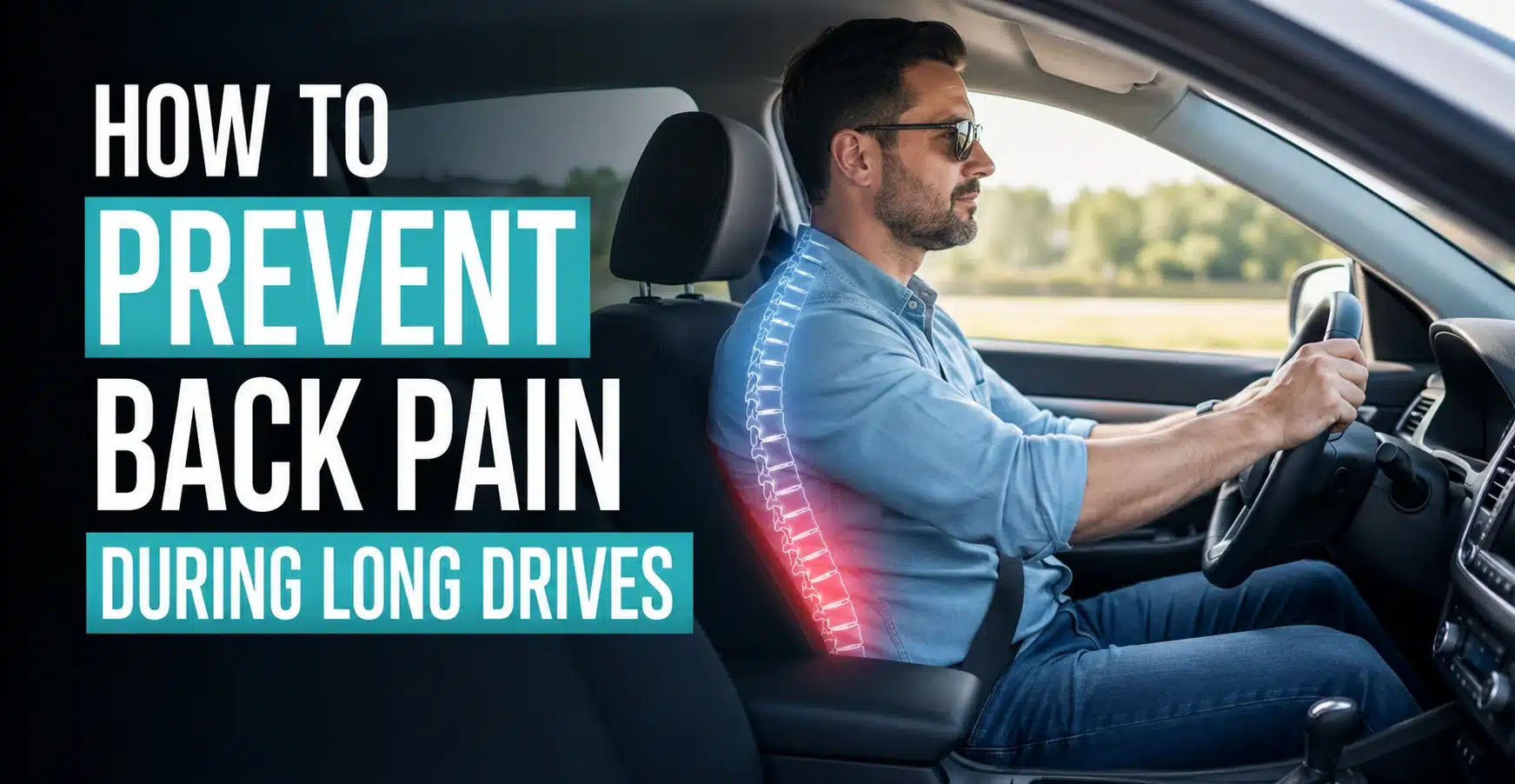
A car seat asks more of your spine than most people realize. It’s not simply sitting — it’s sitting while absorbing road vibration, reaching asymmetrically for the wheel, and often twisting to check mirrors or blind spots. Back pain while driving combines several stressors that don’t show up when you’re seated at a desk.
What Makes Driving Different From Other Sitting
Office chairs are static. Car seats are not. Road vibration transmits low-level, repetitive shock straight into your pelvis and lumbar spine for the entire drive. Add in the asymmetry of reaching toward a wheel positioned slightly to one side, and your spine ends up working through a subtly rotated position for hours at a time.
- Vibration exposure fatigues spinal stabilizing muscles faster than static sitting does.
- Reaching for the wheel with both arms forward pulls your shoulders and upper back into a rounded position, which cascades down into your lower spine.
- Checking mirrors and blind spots repeatedly loads your spine through rotation, a movement most car seats don’t support well.
- Poor lumbar support in many seats lets your pelvis tilt backward, flattening your natural lower back curve.
- Pedal use, particularly in stop-and-go traffic, keeps one leg in a fixed position while the other moves, creating uneven pelvic loading.
Setting Up Your Seat Correctly
Seat position matters more than most drivers assume. Your hips should sit slightly higher than your knees, and the seat back should tilt no more than 100 to 110 degrees from the seat base. A rolled towel or dedicated lumbar cushion placed at the small of your back can restore the curve most factory seats fail to support.
The Physio Village Approach
A better seat cushion helps, but it can’t undo weeks or months of accumulated joint restriction and muscle tightness from regular driving. Our physiotherapists start with a hands-on assessment of your spine, hips, and shoulders, since driving-related pain often involves more than the lower back alone. Manual therapy — joint mobilization through the lumbar and thoracic spine, combined with soft tissue release through the hip flexors and shoulders — addresses the specific restrictions driving has created. We then guide you through seat setup and simple in-car movement strategies so the improvement holds up on your next long drive.
Practical Tips for Long Trips
- Stop every 60 to 90 minutes to walk for a few minutes, even in a parking lot.
- Adjust mirrors before you set off so you’re not repeatedly twisting to see around blind spots.
- Use a lumbar support cushion if your seat lacks built-in support.
- Keep your seat close enough that you’re not stretching to reach the pedals or wheel.
- Do a few gentle spinal rotations and hip flexor stretches at rest stops.
When to See a Physiotherapist
Mild stiffness after a long drive that resolves within an hour is common. Pain that persists into the next day, worsens with each trip, or comes with numbness or tingling in your legs is worth a proper assessment.
Frequently Asked Questions
Does seat position really make a difference for back pain? Yes. Hip height relative to your knees, seat back angle, and lumbar support all directly affect how much load reaches your lower spine during a drive.
Why does my back hurt more after driving than sitting at a desk? Road vibration and the asymmetry of reaching for the wheel add stressors that static desk sitting doesn’t involve.
How often should I take breaks on a long drive? Every 60 to 90 minutes is a reasonable target, giving your spine a chance to move through its full range before stiffness sets in.
Physio Village can assess your driving posture and spinal mechanics together, then treat the restrictions that are turning your commute into a source of pain.
Book Your Assessment: Book at Physio Village Oakville Book at Physio Village Brampton