
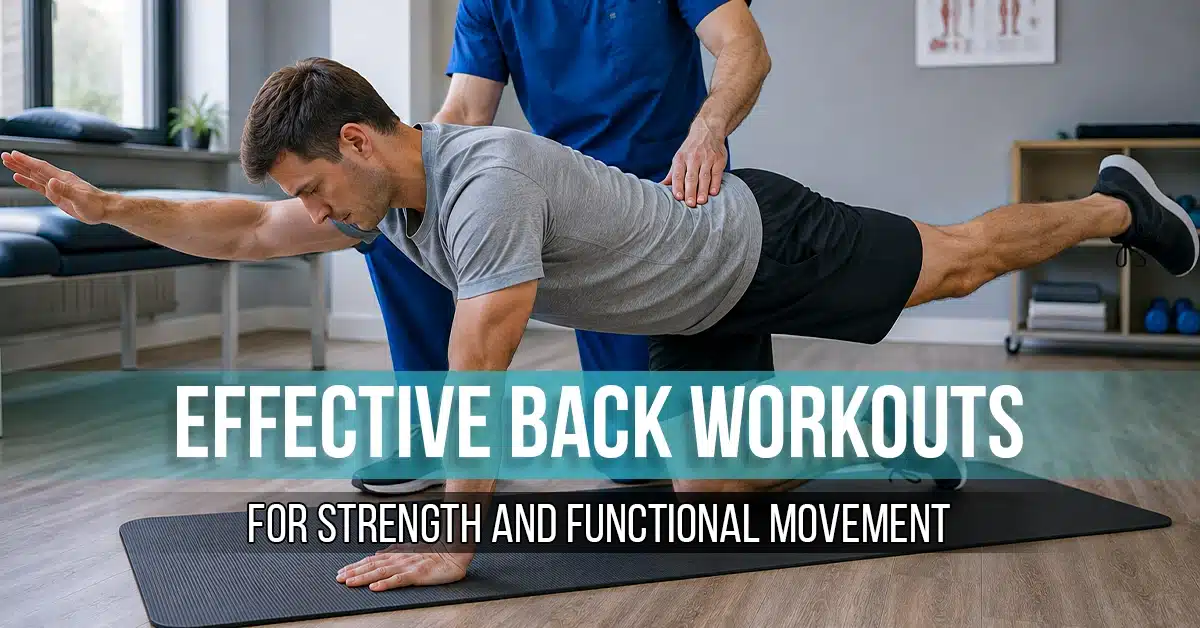
Back workouts are not where back rehabilitation begins. That statement runs counter to what most patients expect when they arrive at a physiotherapy clinic—but it reflects the clinical reality: loading a dysfunctional movement pattern does not correct the dysfunction. It strengthens it.
The lower back workouts that fail—the ones that produce short-term gains followed by a familiar return of pain—almost universally skip the assessment step that determines whether the exercise being prescribed will help or reinforce the problem. The issue is not the exercise. It’s what the exercise is being applied to.
Why Back Workouts Need a Clinical Foundation First
Every meaningful back workout is an expression of movement quality. Hip hinge, spinal stability, rotational control—each depends on joint mobility and neuromuscular recruitment patterns being correct before external load is introduced.
When a lumbar segment is restricted, spinal workouts create compensatory motion at adjacent segments. When the deep stabilisers—multifidus and transversus abdominis—are inhibited by pain, stability training activates the superficial muscles that override them. The result is a patient who is progressing on load while remaining fundamentally vulnerable to re-injury, because the underlying mechanical problem was never addressed.
This is why the clinical sequence at Physio Village begins with assessment and manual therapy—not the exercise list.
Manual Therapy: The Clinical Prerequisite for Progressive Training
The case for starting with manual therapy before progressive training is mechanical and well-supported clinically. Joint mobilisation of restricted lumbar and thoracic segments restores the available range of motion within which correct movement patterns become possible. A proper hip hinge cannot be performed if the lumbar-hip rhythm is blocked by a stiff segment at L3-L4. Anti-rotation stability training cannot recruit correctly if thoracic rotation is restricted and compensated by lumbar shear.
Soft tissue release to the thoracolumbar fascia, erector spinae, and hip musculature addresses the active tension patterns that inhibit deep stabiliser recruitment. When the multifidus cannot fire correctly because overlying superficial tissue is guarding, no amount of progressive training teaches it to recruit correctly—the guarding must be released manually before the neuromuscular work can take effect.
Neurodynamic mobilisation matters here as well. Neural tension limits range of motion during hip hinge and squat patterns. A patient who cannot achieve full hip flexion during a Romanian deadlift without reproducing posterior thigh symptoms may have sciatic nerve tension rather than hamstring tightness. These are not addressed by the same intervention, and confusing them produces exercises that aggravate rather than rehabilitate.
At Physio Village, both the Oakville and Brampton clinicians spend a significant portion of each early session performing this manual work before any exercise is introduced. The subsequent exercise programme is more effective precisely because the tissue environment is prepared.
Phase 1 — Spinal Stability Training
Stability training is the correct entry point for back workouts in any patient who is post-injury, returning from a period of pain-limited movement, or presenting with a history of recurrent lower back pain. The goal is not to challenge strength—it is to re-establish the deep segmental control system before it is asked to manage external load.
Bird Dog: On all fours, extend the opposite arm and leg simultaneously. Hold for five seconds before returning. This trains the deep stabilisers under very low load without introducing flexion or extension stress to the lumbar spine. The most appropriate starting point for most post-injury lower back workouts.
Dead Bug: Supine with arms vertical and hips and knees at 90 degrees. Slowly lower the opposite arm and leg toward the floor without allowing the lumbar spine to extend or the lower back to lift. This is anti-extension stability training—the movement pattern most directly relevant to lifting in daily life.
Pallof Press: With a band or cable attached at chest height, stand perpendicular to the resistance. Press straight out and hold for three seconds. This is anti-rotation stability—one of the most undertrained components of lower back rehabilitation and one of the most clinically relevant to spinal workouts.
McGill Curl-Up: A modified abdominal exercise in which the lumbar curve is maintained throughout the movement, loading the rectus abdominis without creating flexion shear at the lumbar segments. Validated extensively in clinical research on disc pathology as a safe abdominal strengthening option.
Phase 2 — Functional Exercises
Once stable motor patterns are established and the patient can perform Phase 1 exercises without compensation for three consecutive sessions, functional exercises introduce load through full movement patterns. This transition is based on clinical response—not on elapsed time.
Hip Hinge (Romanian Deadlift): Hinge at the hips while maintaining a neutral lumbar curve, loading the posterior chain—hamstrings, glutes, lumbar erectors. This movement pattern is most directly related to the mechanics involved in most lower back injuries, and training it correctly is the most protective thing a patient can do for long-term spinal health.
Goblet Squat: A front-loaded squat that encourages thoracic extension and hip flexion depth. Less lumbar-dominant than a barbell squat, making it appropriate earlier in the rehabilitation progression without sacrificing the quadriceps and hip development relevant to functional movement.
Suitcase Carry: A unilateral loaded carry that trains lateral trunk stability and overall stiffness under dynamic conditions. Directly translates to the asymmetrical loading demands of carrying tasks in daily life and is consistently underused in lower back rehabilitation programmes.
Step-Up with Load: Single-leg loading in a functional position that trains hip stability, quadriceps strength, and postural control simultaneously. Appropriate once single-leg stance is stable under body weight.
Phase 3 — Progressive Training for Return to Full Function
Progressive training in the final phase reintroduces compound loading with the expectation that movement quality has been established and the patient is training to build resilience rather than recover basic function.
Conventional deadlift, overhead press, loaded carries, and sport-specific training form the core of this phase. Barbell squat and back squat patterns, where indicated by the patient’s functional demands, are introduced here with ongoing attention to thoracic mobility requirements. Athletes return to sport-specific loading progressively, with volume and intensity managed in relation to how the tissue responds across training weeks.
The critical principle in this phase is that monitoring continues. Progressive training that produces post-session symptoms lasting more than 24 hours is a signal that load or volume has outpaced tissue adaptation—and the programme is adjusted, not abandoned.
Common Mistakes in Lower Back Workouts
Progressing directly from acute rest to Phase 3 compound loading without the stabilisation phase is the most consistent error in self-managed back rehabilitation. Skipping Phase 1 feels efficient until the recurrence happens.
Read Also: Exercises for Lower Back Pain A Complete Clinical Guide
Neglecting the posterior chain in favour of anterior chain work—abdominal crunches, leg raises, planks exclusively—creates an imbalance that increases the lumbar load during loaded movement. Back workouts that do not include hip hinge and posterior chain loading are incomplete clinically.
Training through pain, rather than identifying and expanding the pain-free movement window, converts manageable acute presentations into chronic ones.
Frequently Asked Questions
Q: What is the best back workout for lower back pain rehabilitation?
There is no single best exercise. The appropriate back workout depends on the phase of recovery, the specific structural issue involved, and the movement deficits identified during clinical assessment. Bird dog and dead bug are appropriate starting points for most post-injury presentations; compound loading is introduced progressively once stability is established.
Q: Can I perform back workouts while still experiencing some pain?
Pain-free range of motion training is appropriate in most presentations. Training that reproduces or increases pain is contraindicated until the source of irritation is addressed clinically. The goal is to find and expand the pain-free training window—not to push through symptoms.
Q: How is stability training different from general core exercises?
Stability training targets the deep segmental stabilisers—multifidus and transversus abdominis—through low-load, controlled movement patterns. Generic core exercises frequently activate the superficial muscles while the deep system remains inhibited, which is why they often fail to prevent recurrence. The distinction is clinically meaningful.
Q: How many sessions per week should I do back workouts?
During Phase 1 stability training, two to three sessions per week with recovery days between is appropriate. Progressive training in Phase 3 typically follows a three to four sessions per week structure. Volume and frequency are calibrated based on the individual’s tissue response and recovery between sessions.
Q: Do I need physiotherapy before starting back workouts on my own?
If you have a history of back pain, current symptoms, or a previous injury, a clinical assessment is advisable before beginning a structured training programme. It identifies the restrictions and motor pattern errors that would otherwise be reinforced under progressive load.
Q: What is the difference between spinal workouts and lower back workouts?
The terms overlap considerably but spinal workouts more often emphasise stability and control of the full spinal column including the thoracic region, while lower back workouts target the lumbar musculature and posterior chain specifically. An effective rehabilitation programme addresses both.
The 2-Minute Self-Assessment: Core Stability Check
Lie on your back with knees bent. Place one hand under your lumbar spine. Slowly extend one leg, straightening it toward the floor, without allowing your lumbar curve to flatten against your hand or your pelvis to rotate.
If you cannot extend the leg past 45 degrees without losing lumbar position, your deep stability system is not yet ready for loaded back workouts. This is a clinical finding—not a reason to avoid exercise, but a clear signal to begin with Phase 1 stability work before introducing external load. Bring this finding to your first appointment at Physio Village Oakville or Brampton.
Key Takeaways
- Back workouts are stage-dependent—loading a dysfunctional movement pattern makes the dysfunction stronger, not corrected
- Manual therapy restores joint mobility and neuromuscular patterns before progressive training is introduced—the exercise is more effective because the tissue is prepared
- Phase 1 stability training re-establishes the deep segmental control system before compound loading begins
- Functional exercises and progressive training are the later stages of a structured programme, not the entry point
- Training through pain consistently produces setbacks—the goal is to identify and progressively expand the pain-free training window under clinical supervision
The 2-Minute Check: Try the core stability check above. Note at what degree of leg extension your lumbar position changes—and bring that observation to your first clinical session.
Book Your Assessment: Book at Physio Village Oakville Book at Physio Village Brampton