If you live in Brampton and work in Oakville (or vice versa), you don’t need a GPS to tell you that the 401 and the 410 are basically giant, slow-moving parking lots. While the GTA commute is a fact of life, the chronic back pain that comes with it doesn’t have to be.
Spending 60 to 90 minutes in a car seat—often in stop-and-go traffic—places a unique mechanical stress on your spine. At Physio Village Clinic, we see the “commuter’s back” every day. Here is your professional guide to reclaiming your comfort behind the wheel.
Why Does Heavy Traffic Cause Commuters’ Back Pain?
It’s not just the duration of the drive; it’s the static nature of it. When you’re stuck in traffic near the Brampton City Centre or crawling toward the QEW, your body enters a “hibernation mode” that is destructive to your posture.
Stiff and Fatigued Muscles
Holding one position for too long reduces blood flow to your spinal muscles. By the time you reach your exit in Oakville, those muscles are “locked,” leading to that familiar stiffness when you finally try to stand up.
Deactivated Core
In a car seat, your trunk tends to slump. This “deactivates” your deep core stabilizers. Without the core supporting your spine, the full weight of your upper body collapses onto your lower back discs.
Tight Hamstrings and Hips
Driving requires your right leg to be in a constant state of slight tension between the gas and brake. This keeps your hip flexors and hamstrings in a shortened, tight position, which eventually pulls on your pelvis and creates lower back strain.
How To Make Your Commute Comfortable & Pain-Free?
Prevention starts before you put the car in drive. A few ergonomic tweaks can change your entire recovery timeline.
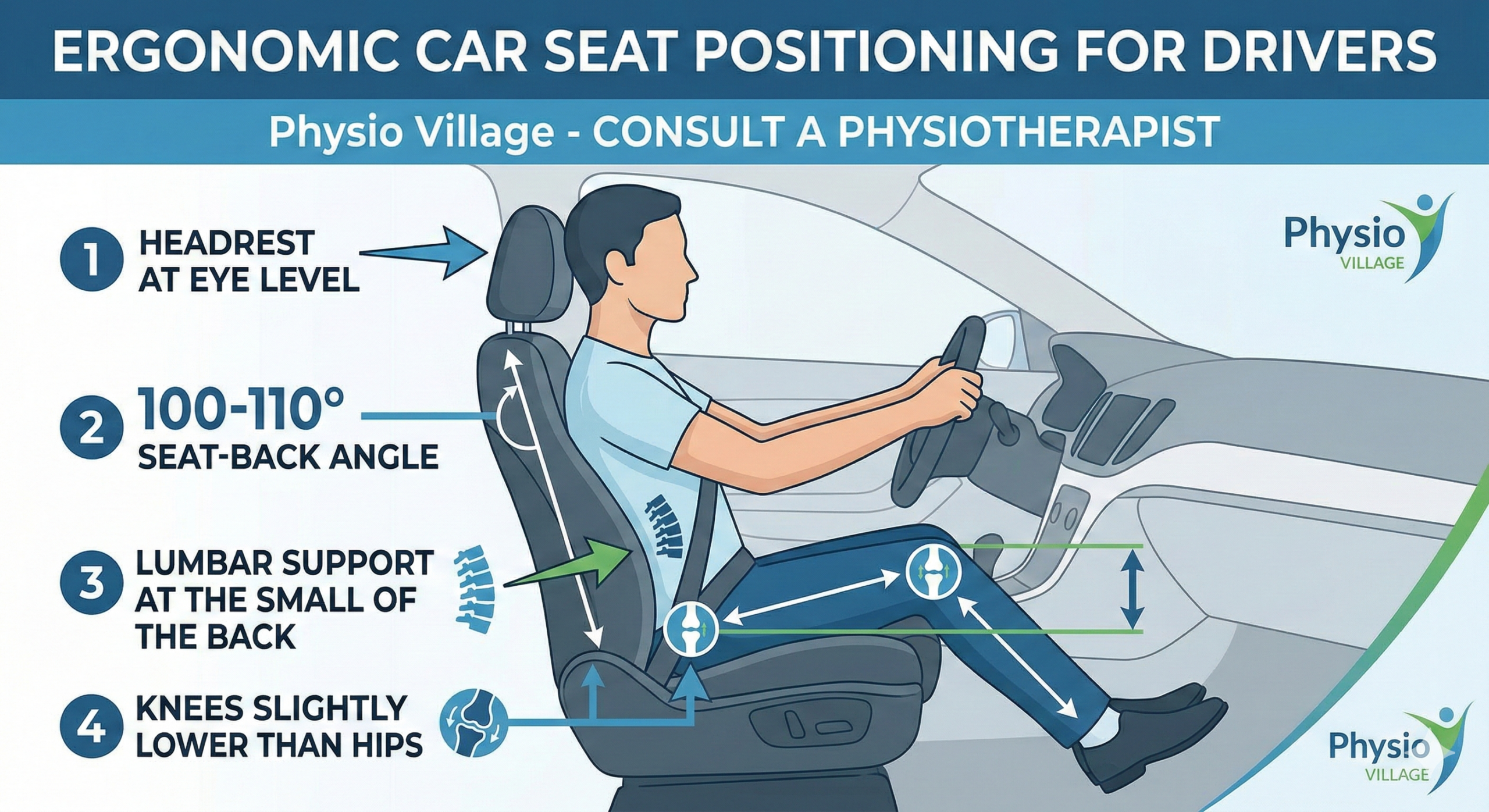
- Adjust Your Seat: Your knees should be slightly lower than your hips to maintain the natural curve of your spine.
- Use Lumbar Support: If your car doesn’t have built-in support, a small rolled-up towel at the small of your back can prevent the “C-shape” slump.
- The “Two-Hand” Rule: Keeping both hands on the wheel helps keep your shoulders square and prevents the ribcage rotation that causes one-sided back pain.
What Are Some Easy Stretches to Reclaim Your Spine in Traffic?
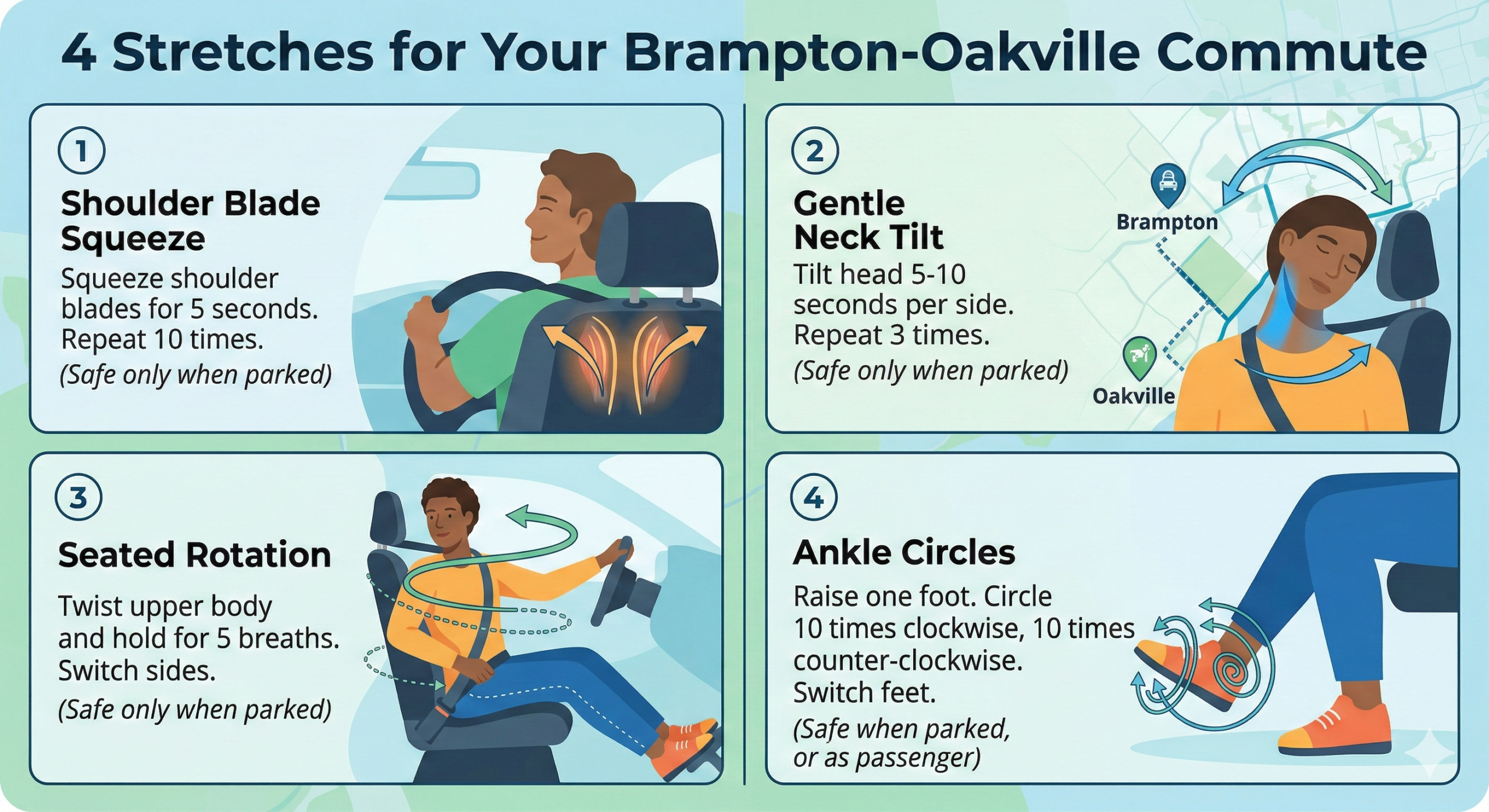
You don’t need to get out of the car to start your rehab. Use the red lights and the gridlock to your advantage with this In-Car Stretch Routine:
- Shoulder Blade Squeezes: Pull your shoulder blades back and down as if trying to hold a pencil between them. Hold for 5 seconds. This counters the “steering wheel slouch.”
- Seated Trunk Rotation: While stopped, safely grip the side of your seat and gently rotate your torso to one side. This “wrings out” the stiffness in your mid-back.
- Seated Piriformis Stretch: If you have an automatic and are safely stopped, cross one ankle over the opposite knee to stretch the glutes—the primary culprit in sciatica-like pain.
- Seated Hamstring Stretch: Straighten your leg as much as the footwell allows and flex your toes toward your shin.
How to Maintain a Neutral Posture Even After the Commute?
For many, the drive is just the “warm-up” for 8 hours at a desk. To prevent disc herniation, your post-commute environment must be optimized.
- The Chair is Your Foundation: Ensure your office chair supports your lumbar spine and allows your feet to rest flat on the floor.
- Keyboard & Mouse Placement: These should be at a height where your elbows are at a 90-degree angle. Reaching too far forward strains the muscles between your shoulder blades.
- Monitor Height and Distance: Your eyes should be level with the top third of the screen to prevent “tech neck” from worsening your back alignment.
How a Physiotherapist Can Help?

Sometimes, a lumbar roll isn’t enough. If your pain is persistent, it’s time to move from “self-management” to “professional recovery.”
When to See a Physiotherapist for Back Pain?
If you experience radiating pain down your leg, numbness, or pain that persists for more than three days after a long drive, you need an assessment.
Common Physiotherapy Methods to Treat Back Pain
At our Brampton and Oakville locations, we don’t do “generic.” We provide:
- Hands-On Treatment (Manual Therapy): We physically mobilize the joints and soft tissues that have stiffened during your commute.
- A Personalized Exercise Prescription: We give you specific movements to “reactivate” your core and “reset” your hips.
- Education for Empowerment: We teach you exactly how to sit, move, and drive to ensure the pain doesn’t return.
FAQ: Commuting and Your Back
How to reduce back pain while driving a car?
The best way is to change positions frequently. Even a 1-degree tilt in your seat every 20 minutes can redistribute the pressure on your spinal discs.
What is the best way to prevent back pain?
Consistent movement and core strength. A strong “natural corset” protects your spine from the vibrations and static posture of driving.
Which of the following positions should be avoided in severe back pain?
Avoid “slumping” or leaning to one side (like resting your elbow on the centre console). This creates an asymmetrical load on your discs that can worsen a herniation.
How do you prevent or reduce back pain suggested for riders?
Take breaks every 50-60 kilometres. Get out, walk for 2 minutes, and perform a standing back extension (leaning backward) to counter the sitting posture.
Take the Driver’s Seat in Your Recovery
Your commute shouldn’t feel like a workout for your pain tolerance. By making small adjustments to your car setup and incorporating seated stretches, you can arrive in Oakville or Brampton feeling refreshed rather than wrecked.
Don’t let the 401 control your health. If your drive is becoming a source of daily pain, come see us for a hands-on assessment.